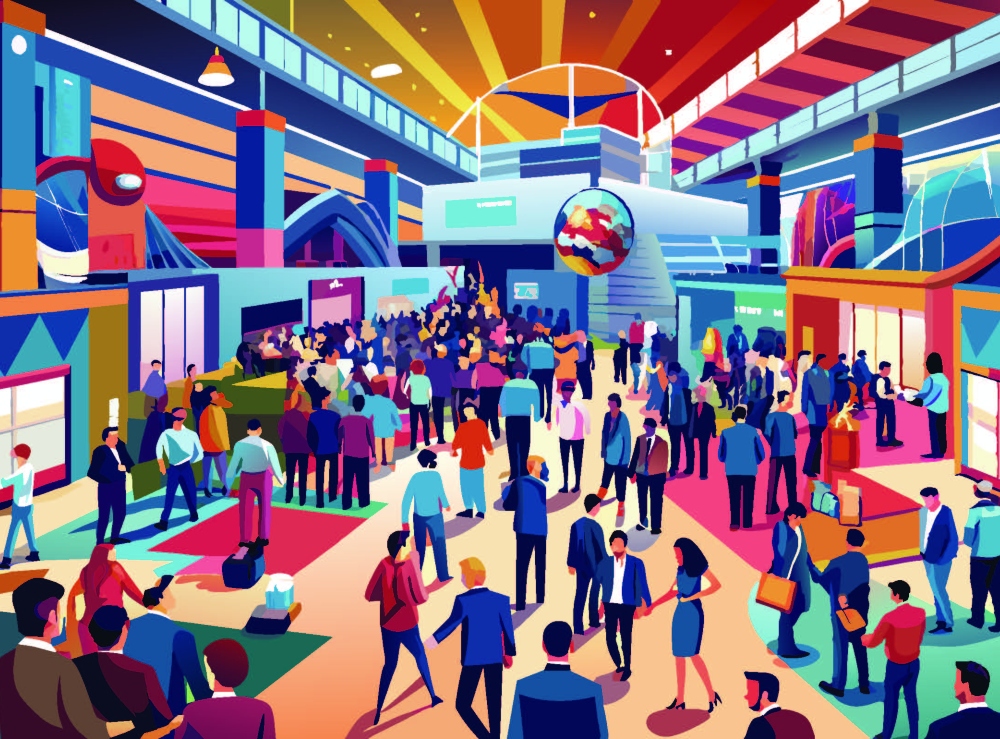
After taking a massive hit during the COVID-19 pandemic, trade shows and other mega-events rebounded in a big way. As of this year, most have reached their prepandemic performance levels, and more than a third have exceeded them, according to the Dallas-based Center for Exhibition Industry Research.
Along with growing numbers, large events are changing in other ways that reflect world conditions and attendee preferences for communication and engagement. Technology, for one, is evolving rapidly, including the introduction of new ticketing apps and other software programs that allow organizers to manage the entire event all in one place. Exhibition halls also are revamping, shifting away from the traditional grid of elongated aisles lined with booths to flexible formats that make the gatherings more experiential and immersive.
Safety also is at the forefront of everyone’s minds, even more so after recent incidents involving security breaches at large events, including at the White House Correspondents’ Association Dinner in Washington, D.C., this year. For this article, a panel of industry pros offers ideas and inspiration on these topics and more to draw rave reviews after your next mega-event.
The Right Venue
Some mega-events are staged in the same location every year, like the Consumer Electronics Show (CES) in Las Vegas and the Veterinary Meeting & Expo (VMX) in Orlando, Florida. Others move around from city to city. And whether the host area matches your event needs to a venue’s spaces and amenities is more complex than looking at seating charts and floor plans.

Perhaps you require both a massive exhibition hall and an intimate dining room for a private board dinner. Also consider including a greenroom for speakers before they take the stage, areas for animals to do their business, or seating areas where attendees can make phone calls or check emails between sessions rather than standing in the hallways. “Look past the aesthetics and check the guts of the building,” advises Colin Faul, vice president of production at Agency EA, a Chicago-based marketing and event-planning company. He calls these elements “hidden logistics.”
“Check for adequate storage for dead cases and empty equipment trunks,” he says. “Evaluate the loading docks and the path from the truck to the ballroom. If you need a forklift or have a long push, it adds significant time and labor costs.” Proximity to airports and public transit is important, but so is a staging area where dozens of Ubers can pull up simultaneously, Faul adds.

A common scenario in the venue-selection process is for a client to outgrow a venue’s space, but with years still left on their facility contract. “That’s when we have to advise pivots,” says Laura Werfelmann, event director at 360 Live Media, a full-service events agency with offices in Chicago and Washington, D.C. “For one client, instead of having an overflow room for their general session, we set up a live stream to the guest rooms in the hotel.”
“It’s [about] making sure we are intentional for everyone, not just one type of attendee,” adds Christina Filan, director of operations and event management at The Collective, an agency within BCD Meetings & Events of Chicago.
Technology Rules
Show apps are no longer optional; they are critical infrastructure for sending and receiving instant updates, rain plans, and other information. The apps also are increasingly sophisticated, with customizable features and branding graphics.
“Nowadays, mobile apps are built in a way that is flexible,” Werfelmann says. “You can even put geofencing in, so a notification pops up on your phone when you walk into a particular room.” Some planners add menus to event apps, so attendees with dietary preferences or restrictions can plan their meals ahead of time. CES, which is hosted by the Consumer Technology Association of Arlington, Virginia, had some 150,000 international attendees across a dozen official venues in January. The event’s app included blue-dot navigation, translation services, real-time transportation updates, and networking features to facilitate connections.
Events that involve ticket sales need multiple check-in modes running at the same time—pre-event purchase, on-site or box-office purchase, and a self-serve kiosk, says Nausheen Punjani, cofounder of Eventeny, a cloud-based meeting management software company based in Atlanta. “Even on event day, people purchase tickets from their phones while standing in line, because it makes on-site check-in faster,” she says.
Whatever platform event organizers use, Punjani recommends adding features for real-time ticket sales and check-in analytics to facilitate course correction as needed. “If you can see the attendee flow as it’s happening, you can reroute staff or open a second entry before a crowding issue becomes a safety issue,” she says.
On the Floor
It’s easy to feel lost at an event with thousands of attendees swarming through the spaces. Savvy planners create microcommunities, an effective way to drive engagement and connection.
VMX is a mega-event that gathers about 29,000 veterinarians, veterinary nurses, managers, and other animal practitioners. Many are licensed, so the agenda has a strong continuing education component, says Ellen Edmonds, vice president of public relations for the North American Veterinary Community, which hosts the event. Scattered throughout the expo are special-interest lounges, such as those for first-time attendees and alumni from various universities. There also are fitness classes like “Puppy Pilates” and “Goat Yoga,” as well as the Cat Nap Cafe, where attendees relax and cuddle with felines. All the animals are adoptable. “The [event] can be overwhelming, but there’s nothing more relaxing than snuggling a puppy or a kitten,” Edmonds says. “It’s magical.”

Jennifer LeMaster, president and CEO at the Seattle Convention Center, recounts a client who transformed the facility’s exhibition hall into a faux nature park with meandering pathways, foliage, flower arrangements, swings, and conversation areas with soft
seating. Vendors set up their booths along the paths. “When you think about the experience from an entertainment lens and activation lens, you see a lot of people, but it doesn’t feel crowded,” she says.
In June, KeHE, a distributor of specialty grocery products based in Naperville, Illinois, and a 360 Live Media client, held its annual holiday show at McCormick Place in Chicago for an estimated 5,000 attendees. The exhibition hall is formatted with a designated wellness center where attendees can try out red-light therapy masks and receive energizing vitamin B12 shots. “It’s important for people to not be afraid to try something new
to stay relevant and successful,” says Werfelmann.

Help Wanted
Events like the triannual NPE: The Plastics Show, another 360 Live Media client, which hosts 55,000-plus attendees at the Orange County Convention Center in Orlando, and the Northwest Flower & Garden Festival, which brings about 60,000 visitors to the Seattle Convention Center, require a small army of temporary help. Mostly unpaid, these volunteers assist full-time staffers and reduce pressure on the event budget.
“All volunteers, regardless of their role, should know where the bathrooms, water stations, and charging ports are,” Faul says. VMX recruits volunteers from a combination of sources,
Edmonds notes. Many are repeat volunteers who enjoy the experience and the environment full of animal practitioners. Others are friends and family of North American Veterinary Community staff, college students studying animal sciences, and teenagers needing credit for volunteer hours.
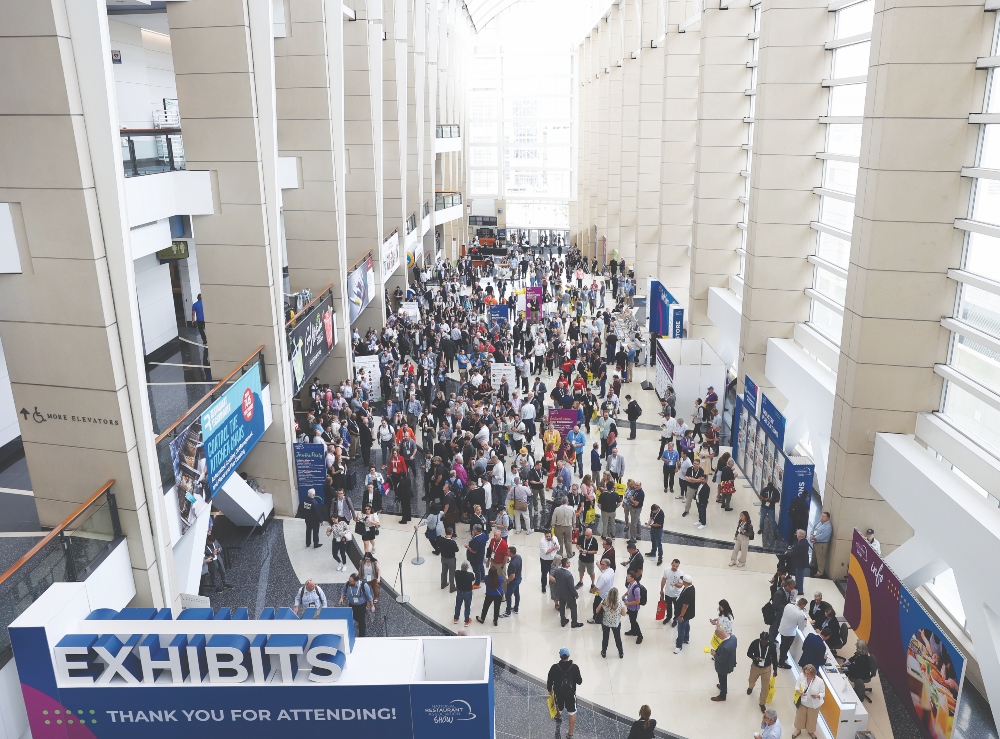
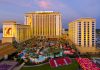
food-service and hospitality attendees each year. || Courtesy of McCormick Place
CES has a program for which partners and close relatives of the full-time staff of the Consumer Technology Association are offered the opportunity and a stipend to travel to Las Vegas to work at the show. “Given that our staff are often away for a week or longer to work CES, this allows them to spend time with their loved ones while also expanding our pool of talent to support a show the size of CES,” says John T. Kelley, vice president and show director of CES for the Consumer Technology Association.
Playing It Safe
Protection for speakers, honored guests, and entertainers requires different levels of security, depending on the person. Many VMX speakers are licensed veterinarians who need their own continuing education credits, so they mingle in the classrooms. Entertainers might opt in or out of bringing their own security details.
The most prominent headliners typically require a synergistic team of city, venue, host organization, and personal security handlers, potentially including the U.S. Secret Service. Filan, who formerly worked in the hotel industry, recalls the strategy when a president came to town: The security team designed four different arrival times and routes, down to the minutiae of entrances and exits, as well as the locations of stairwells and elevators. Everyone involved knew all four plans and their respective roles, but only the security team leader was empowered to decide—at the last minute—which plan to execute. Everyone knew what to do, but very few people knew everything, which helped prevent leaks.
In event of inclement weather, Filan adds evacuation procedures to the event’s mobile app and assigns trained staffers to certain areas of the venue, like muster stations on a cruise ship.

Security protocols evolve, partly due to technological advances and partly in response to client prorities, LeMaster says. Standard operating procedure at the Seattle Convention Center is to activate cameras in public areas and garages. Some groups view such cameras as premium safety elements, but others see them as invasive. “There are times you might have a client who, for whatever reason, has a sensitivity about who might have access [to the footage,]” she says. “We have to work through those [concerns] and maybe change the protocols.”
The key, Filan says, is to have plans for every type of emergency, and hope you never have to implement them. “We are seeing, even with the uncertainty in the world, that people want contact [with others],” she says. “Registrations are up. People are up and about. They want to network. But safety is No. 1. We’re all thinking intentionally to make people feel safe to travel. That’s the biggest thing.”
The Consumer Technology Association’s Kelley agrees. “Ultimately, the success of a large-scale event isn’t just measured by attendance,” he says. “It’s measured by how safely and seamlessly people connect, collaborate, and get business done.”
360livemedia.com
agencyea.com
bcdme.com
ces.tech
eventeny.com
gardenshow.com
kehe.com
navc.com/vmx-event
npe.org
seattlecc.com